2014/03/19

Fact-Checking the Keystone XL Pipeline - GD Part 2.2


Check out factcheck.org's article on the Keystone XL pipeline, "Pipeline Primer." If you don't feel like reading much, you can watch their video instead:


Factcheck.org's Copyright Policy requests full credit to the author and to factcheck.org, that a link to factcheck.org be prominently posted on the website, and that when the article is redistributed that the entire article is posted. But I really really really want you to go to factcheck.org for yourself instead of just reading their article here. They do great work, and have thousands of articles on many many topics.

Here is the article in full, written by Brooks Jackson. I hope you don't find it lazy of me to redistribute this, but as I said, the Copyright Policy insists this is preferable to potentially taking anything out of the original context of the article.
After the full text of the article and sources, I have some comments:


Pipeline Primer

The Keystone XL project: We examine the facts about jobs, spills, climate change and gasoline prices.


Summary

After more than five years of claims and counter-claims about the proposed Keystone XL pipeline, President Obama is expected to make his final decision soon. So we thought it was a good time to sift through the disinformation and lay out some basic facts.
  • Building the pipeline will create jobs in the U.S., but not as many as supporters have claimed, and only for a year or two. The U.S. State Department estimates that 42,100 jobs would be added during construction, but that only 50 workers would be required to operate the pipeline.
  • Oil from Canadian bitumen deposits — which the Keystone would carry from Alberta to the U.S. for refining — results in 14 percent to 20 percent more greenhouse gas emissions than oil typically consumed in the U.S. at present.
  • But that doesn’t mean that stopping the pipeline would prevent Canadians from extracting their crude and getting it to market to be burned, either in the U.S. or other countries. “Such a change is not likely to occur,” State concluded.
  • In fact, much of that oil is reaching the U.S. already — by rail — and more tank-car capacity is being added quickly. Canadians also are proposing two other pipelines to tanker ports on the Pacific coast, and a third project to nearly double the effective capacity of an existing line to the U.S.
  • Pipelines are dangerous, but tanker cars are more so. Rail accidents spilled more oil in the U.S. last year than in all the previous years on record combined. And in Canada, 47 people died in one fiery tanker-train disaster in Quebec last year.

Analysis

The pipeline would be built by TransCanada Corp. and would run 1,179 miles from Hardisty, Alberta, to Steele City, Neb., where it would connect with existing pipelines to refineries on the Gulf Coast. The U.S. segment would be 875 miles long, running through Montana, South Dakota and Nebraska. The 36-inch diameter line could carry up to 830,000 barrels (nearly 35 million gallons) of oil per day.
Because it would cross the U.S.-Canadian border, it would require a finding by the Obama administration that building it is in the national interest. The State Department, after lengthy review, submitted its Final Supplemental Environmental Impact Statement on Jan. 31, and said it would receive public comments until March 7. No date has been announced for a final decision.
The debate over the project has pitted environmentalists — who hope to block the project on grounds that it would worsen global warming and result in hazardous oil spills — against the president’s critics on the right — who say he should have approved it long ago to create jobs and lessen U.S. dependence on oil from less friendly countries.
Jobs
Any big construction project requires workers to build it. How many? The U.S. State Department’s analysis says 3,900 would be employed directly if the job is done in one year, or 1,950 per year if work is spread over two. TransCanada Corp. puts the number higher, saying the project would support 9,000 construction jobs directly.
There would be additional, “indirect” work for companies supplying goods and services, including concrete, fuel, surveying, welding materials and earth-moving equipment required for the project, and “induced” jobs resulting from money spent by workers and suppliers, such as ranchers providing beef for restaurants and construction camps. Counting up everything, the State Department estimates a total of 42,100 jobs could be created.TransCanada has accepted the 42,100 figure for total employment.
Whatever the number, these jobs are temporary, lasting only for the year or two that it would take to complete the project. The number of permanent jobs is much lower. “The proposed Project would generate approximately 50 jobs during operations,” according to State’s analysis.
House Republicans are still claiming the project would create 120,000 jobs. But that’s based on outdated information. The House Energy Committee’s GOP majority website extrapolates from figures given by TransCanada two years ago — for a much longer pipeline than is now proposed.
That was before President Obama initially rejected the original Canada-to-Texas project pending changes in the route. Since then, TransCanada has completed a 485-mile segment of the original project — running from Cushing, Okla., to refineries in Texas — which did not require presidential approval because it did not cross an international border. Now named the “Gulf Coast Pipeline Project,” construction began in August 2012 and was completed this year. It went into operation on Jan. 22.
The current Keystone XL project includes 875 miles within the U.S. And, as noted, even TransCanada says it would create about 42,000 temporary jobs, not 120,000.
Environment
Critics of the pipeline are fond of saying it would carry “the dirtiest oil on the planet,” and there is no question that the oil is significantly “dirtier” than most in the sense that it results in more greenhouse gas emissions.
It comes from Alberta and parts of Saskatchewan, in what the industry calls “oil sands” and environmentalist critics call “tar sands.” By either name, they are vast deposits of bitumen — a form of petroleum so dense that at a temperature of 52 degrees Fahrenheit it is “hard as a hockey puck,” according to the Canadian Association of Petroleum Producers. It must be heated or diluted to be made to flow through pipes.
The bitumen is found mixed with sand and clay. Extracting it requires a good deal of energy — either through open-pit mining from surface deposits or by injecting steam into deeper, “in situ” (in place) sites. Refining it into useful fuels also requires more energy — and hence more emissions — than lighter forms of petroleum.
How much “dirtier” is it? The nonpartisan Congressional Research Service surveyed published scientific literature on the subject, and those studies found variously that getting Canadian bitumen produced and processed into fuel produces between 70 percent and 110 percent more greenhouse gas emissions than the weighted average of transportation fuels now used in the U.S. That’s what’s called a “well-to-tank” figure, the measure preferred by critics.
However, once it is in the tank, gasoline or diesel fuel that comes from Canadian bitumen is no different than fuel from any other form of petroleum. And burning the fuel in car and truck engines produces a lot more emissions than producing it and getting it to the pump.
So over the entire “life cycle” of a fuel — from in the ground to out the tailpipe — burning a gallon of fuel from the Canadian oil results in 14 percent to 20 percent more greenhouse gas emissions, on average, than burning a gallon of currently available fuel, according to the CRS study. That’s called a “well to wheel” figure. The State Department’s final environmental report put the well-to-wheel figure at 17 percent — squarely in the middle of the published studies surveyed by CRS.
CRS estimated that oil flowing through the Keystone pipeline would result in an increase in U.S. emissions of greenhouse gases equivalent to adding somewhere between 770,800 and 4.3 million passenger vehicles. But whether that would mean any increase at all in globalemissions “remains uncertain,” CRS said. And the State Department said “such a change is not likely to occur.”
State said Canadian oil will probably end up being produced and burned anyway, even if the Keystone is not built. It said new data and analysis indicate that “rail will likely be able to accommodate new production if new pipelines are delayed or not.”
Last year the Environmental Protection Agency officially questioned a similar conclusion contained in an earlier draft of the report, and said State should “provide a more careful review of the market analysis” that supported it. State did so, conducting economic modeling of 16 different sets of supply-demand assumptions and pipeline constraints, which it said showed that “cross-border pipeline constraints have a limited impact on crude flows and prices.”
And meanwhile, more and more Canadian oil is already coming to the U.S. in tanker cars, just as State predicted.
Alternatives
Railroad Tank Cars: A substantial amount of Canadian oil is already entering the U.S. by rail, in tank cars, and the amount carried this way is rising sharply. No White House approval is required.
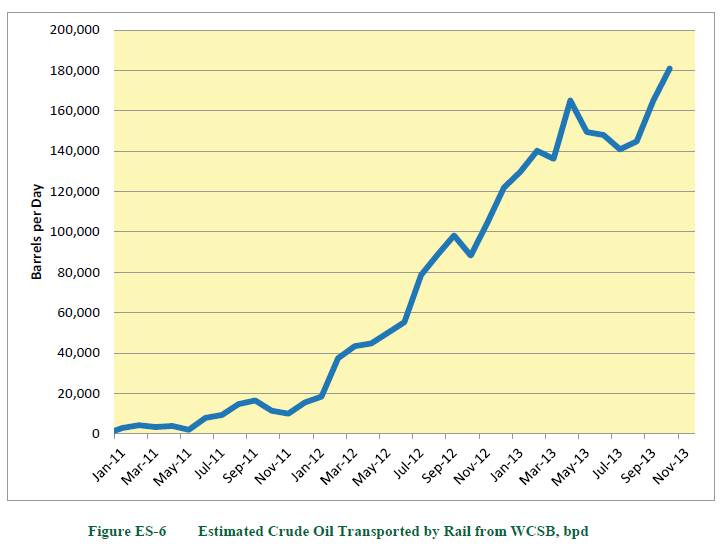
Figure ES-6
Rail shipments have skyrocketed since the time the White House rejected the original Keystone route, when the shipments were less than 20,000 barrels per day. The State Department’s final environmental report estimated that 180,000 barrels per day were already being transported by rail from the Western Canadian Sedimentary Basin, amounting to nearly 22 percent of the volume that the Keystone could carry (830,000 barrels per day). And the industry is adding new rail capacity rapidly.
For example, on Dec. 20, plans for a new loading facility in Edmonton (Alberta’s capital) were announced. It is projected to be in operation by the end of 2014, with an eventual capacity to load 250,000 barrels per day for shipment to North American refineries. Another new rail terminal is planned for Hardisty (where the Keystone pipeline would originate) with a capacity of 140,000 barrels per day, to begin operations early this year. The international information company IHS estimates that as much as 450,000 barrels per day could be moving by rail by the end of 2014, according to CNBC.
Other Pipelines: Besides the Keystone, three other pipeline projects are being proposed to carry Alberta crude oil to market. Two would carry it across the mountains of British Columbia to ports on Canada’s Pacific coast, to be loaded on tankers and shipped mostly to China and other Asian markets (and with some going to California), while a third would nearly double the effective capacity of an existing line to the U.S. 
Kinder Morgan proposes to nearly triple the capacity of its existing Trans Mountain Pipeline to carry an additional 690,000 barrels per day. The company filed its formal application with Canada’s National Energy Board on Dec. 16, and says that if approved the expanded pipeline could be operational by late 2017. The project faces a long review, but the company says 73 percent of the expansion would be built on existing right-of-way.
Opinion in British Columbia is narrowly divided. A Jan. 22 poll by the Canadian polling company Insights West found that 48 percent said they favored the project, while 43 percent said they opposed it. The poll also showed that support has grown since another poll the previous year, when the pipeline proposal was in a preliminary phase. Insights West said that between the two polls, those favoring the project jumped by 10 percentage points, while those opposing it dropped by 14 points.
Enbridge Inc. proposes to construct an entirely new Northern Gateway pipeline to carry 525,000 barrels per day to the coast, and it has already cleared a major regulatory hurdle. A review panel of Canada’s regulators recommended approval of the project on Dec. 19, finding that it would be “in the public interest” provided that Enbridge complied with 209 conditions, which Enbridge says it is “working hard” to meet. Canada’s natural resources minister, Joe Oliver, says the government will make its final decision by mid-June.
A Jan. 25 poll conducted for a Canadian news agency found the country’s public more likely to support the project (38 percent) than to oppose it (29 percent). And in British Columbia, a Jan. 5 survey by the polling company Ipsos showed 48 percent of British Columbia residents supported the project, while 32 percent opposed.
That could change, of course. A later poll commissioned by environmental groups found that 64 percent of British Columbia residents opposed “allowing crude oil supertankers through B.C.’s northern inside coastal waters” to load oil carried by the proposed pipeline. But the same poll found that 64 percent also said they “believe Enbridge will succeed in building its pipelines and tanker proposal,” while only 12 percent thought it would fail.
Enbridge also proposed March 3 to lay new and larger pipe along its 46-year-old “Line 3″ cross-border pipeline from Hardisty, Alberta, to Superior, Wisc. The company said this would have the effect of “restoring” the line’s effective capacity to 760,000 barrels per dayfrom its current operating limit of 390,000.
The company said this would not require a new presidential permit, prompting an objection from the Sierra Club. Enbridge said the $7 billion project would be the largest in its history, and that it hopes to have it completed by 2017.
Safety
Pipelines can be hazardous. An average of 97,376 barrels (4.1 million gallons) of petroleum and other “hazardous liquids” have been spilled each year in pipeline incidents over the last decade, according to the Department of Transportation’s Pipeline & Hazardous Materials Safety Administration. These incidents have claimed an average of two lives per year, and resulted in more than $263 million in annual reported property damage as well.
Those figures include the most expensive onshore oil pipeline spill in U.S. history, caused when 30-inch pipe operated by Enbridge ruptured on July 26, 2010, near Marshall, Mich. That dumped more than 1 million gallons of Canadian diluted bitumen — the same material that would be carried in the proposed 36-inch Keystone pipeline — into the Kalamazoo River. Enbridge is still struggling to complete the cleanup, having failed to meet a Dec. 31 Environmental Protection Agency deadline for dredging remaining oil residue that settled on the bottom of the river. Although Enbridge initially put the spill at about 840,000 gallons,the EPA said last year that 1.15 million gallons had been recovered and 350,000 cubic yards of contaminated river sediment remained to be recovered. Enbridge said in August 2013 that it had spent more than $1 billion on the cleanup and remediation to date, and the figure continues to rise.
A spill from the Keystone could potentially have similar effects. The Nebraska Department of Environmental Quality, in its final evaluation report on the project, found that the properties of the diluted forms of bitumen that would flow through the state in the Keystone pipeline “are similar in many respects to other heavy sour crude oils.” For what it’s worth, TransCanada says it plans to make the Keystone “the safest pipeline ever constructed in the U.S.,” adding more remote shut-off valves and inspections and burying the pipe more deeply than with other pipelines.
Quebec Oil Train Disaster
Rail transport is even more hazardous than pipelines, however. Last July, 47 people died in a single disaster when an unattended train including 72 tanker cars loaded with crude oil rolled downhill, exploded and burned in the Canadian town of Lac-Mégantic in Quebec province. Forty buildings were demolished, and an estimated 5.6 million liters (1.5 million gallons) of crude oil spilled or burned.
And that calamity is by no means an isolated incident.
The tempo of oil-train accidents has increased along with the sharp rise in tanker shipments, as has the amount of oil discharged. Soon after the Casselton spill, an investigative news report by the McClatchy news agency concluded, based on federal data, that last year more oil spilled in the U.S. from rail tank cars than in all the nearly 40 previous years on record combined.
The incidents continue. On Feb. 13, several cars of a train carrying heavy Canadian crude derailed in Western Pennsylvania. This time only a few thousand gallons leaked out, and there was no fire or explosion.
But later that month, on Feb. 26, a representative of the National Transportation Safety Board, Robert L. Sumwalt, told a congressional hearing that incidents such as the Casselton explosion have become an “increasingly commonplace story.” He said continued use of tanker cars built to meet current federal standards poses “an unacceptable public risk.”  Meanwhile, the Association of American Railroads is pressing the federal government to impose “more rigorous standards for tank cars carrying flammable liquids, including asking for retrofitting tank cars to meet the higher standards or phasing those that cannot be made safer.”
Based on relative safety records to date, the State Department estimated that an average of six deaths per year would result if the Keystone isn’t built and the same amount of oil is shipped by rail instead. More than twice as much oil is likely to be spilled as well, State estimated.
Gasoline Prices
Some proponents have claimed the Keystone project would hold down gasoline prices for U.S. motorists, while foes have claimed that it would do the opposite, at least for Midwestern motorists. We find that neither claim is valid.
The State Department’s analysis concluded that either way, the Keystone project would have “little impact on the prices that U.S. consumers pay for refined products such as gasoline.” That’s because Gulf Coast refineries that process heavy crude could continue to get it from Venezuela or the Middle East, as they do now, if they can’t get it from Canada, the report said. And even if the Keystone isn’t built, Canadian crude still “could reach U.S. and Canadian refineries by rail.”
Other independent experts have said essentially the same thing. Curt Launer, a managing director at Deutsche Bank, has been quoted as saying, “Keystone wouldn’t have a significant impact either way on overall North American energy prices.” Another expert, Morningstar analyst David McColl, was quoted in the same article saying the Keystone would have “no material impact” on gasoline or diesel prices. And even TransCanada doesn’t include lower gasoline prices in its list of the “economic benefits” it claims would result from building the pipeline.
Critics have argued, on the other hand, that Midwestern prices would actually increase, but there’s little support for that idea.
The critics have pointed to an unusual market situation in which crude oil was selling in Oklahoma — as measured by the West Texas Intermediate benchmark price — at far below the world price as measured by the North Sea Brent benchmark. That was due in part to a pipeline bottleneck at Cushing, Okla., that allowed a glut of oil to build up from booming production in the Dakotas and Canada. In 2012, the price for WTI averaged $18 per barrel less than the average world price, according to the most recent report by the U.S. Energy Information Administration. But that “discount” fell below $4 per barrel in July 2013. It rebounded to $14 per barrel in January, and EIA projected that it would average $11 per barrel for all of 2014.
But even when the discount was greater, the lower price of crude oil in the Midwest never translated into consistently lower prices at the pump. A look at EIA’s weekly figures shows that since the start of 2011 the average price of regular gasoline in the Midwest has been only 4 cents a gallon less than the national average, and has ranged anywhere from 20 cents a gallon less to 21 cents a gallon higher. Those who assumed that refiners were passing on their lower costs to consumers were simply wrong.
The State Department analysis came to the same conclusion, finding no correlation between wholesale gasoline prices in the Midwest and the average WTI discount. (See section 1.4.6.1 in the “Market Analysis” section.) In a footnote (number 10), the analysis commented that the cheaper Midwestern crude oil “benefited … refiners,” not motorists.
So, while building the pipeline would undoubtedly provide consumers with some measure of insurance against supply interruptions, as would any additional supply route, there’s simply no evidence that it would have any noticeable effect on prices at the pump, either up or down.
Alleged Conflicts
Foes of the pipeline say the State Department report reflects a pro-industry bias because of an alleged conflict of interest by a firm hired to assist in its preparation. The Sierra Club and Friends of the Earth accused the consultant, Environmental Resources Management, of having ties to the oil industry and hiding a previous connection to TransCanada.
For example, “ERM and TransCanada have worked together at least since 2011 on another pipeline project in Alaska,” Friends of the Earth stated in a July 10, 2013, news release. But ERM said that was wrong. “ERM’s affiliates performed services on the Alaska Project only on behalf of a company other than TransCanada,” the company said in a July 17, 2013, letter to the State Department.
Indeed, the State Department’s Office of Inspector General investigated, and confirmed that work was done for URS Corp., which was hired by Exxon Mobil Corp. The Alaska project was a joint venture between TransCanada and ExxonMobil, but it was ExxonMobil that paid URS, which in turn paid ERM’s affiliates. The inspector general found this didn’t violate any conflict of interest rules, and cleared the department of any wrongdoing in a report released Feb. 26.
Another issue raised by critics is that ERM employees working on the Keystone evaluation had previously worked on projects for TransCanada, and one had formerly been a TransCanada employee. But the inspector general found that didn’t violate any conflict-of-interest rules. The inspector general said the department had substantially followed all regulations for vetting consultants for conflicts of interest, and at times had been even “more rigorous” than required. Overall, the inspector general found that “the Department’s conflict of interest review was effective and that the review’s conclusions were reasonable.”
The Sierra Club and other environmental groups vowed to fight on regardless of the OIG report. On March 3, several hundred people were arrested in student-led protests in Washington, D.C., where some secured themselves to the White House fence with plastic zip ties.
– by Brooks Jackson

Sources

“Keystone XL Pipeline — Overall route map.” TransCanada Corp. website. Accessed 7 Mar 2014.
“Jobs and Economic Benefits; Keystone XL Means Jobs.” TransCanada Corp. website. Accessed 7 Mar 2014.
“Keystone XL: #TimeToBuild.” U.S. Congress; House Energy and Commerce Committee, Republican majority website. Accessed 7 Mar 2014.
“Media Advisory – TransCanada Releases Detailed Keystone XL Job Creation Data.” TransCanada Corp. news release. 10 Jan 2012.
“Obama rejects Keystone oil pipeline.” NBC News. 18 Jan 2012.
“Gulf Coast Pipeline Project.“ TransCanada Corp. website. Accessed 7 Mar 2014.
Transportation Board of Canada. “Railway Investigation R13E0142: Train derailment and fire in Gainford, Alberta.” Website accessed 7 Mar 2014.
“Stopping the Keystone XL Pipeline.” National Resources Defense Council website. Accessed 7 Mar 2014.
“What Are Oil Sands?” Canadian Association of Petroleum Producers website. Accessed 7 Mar 2014.
“What are the Tar Sands?” Rainforest Action Network website. Accessed 7 Mar 2014.
“Recovering the Oil; Oil Sands Today.” Canadian Association of Petroleum Producers website. Accessed 7 Mar 2014.
Lattanzio, Richard K. “Canadian Oil Sands: Life-Cycle Assessments of Greenhouse Gas Emissions.” Congressional Research Service. 15 Mar 2013.
Lamphier,Gary. “Kinder Morgan, Imperial announce $270M rail terminal for Strathcona County.” Edmonton [Alberta] Journal. 20 Dec 2013.
Domm, Patti. “Canadian oil rides south even without Keystone pipeline.” CNBC. 4 Nov 2013.
Kinder-Morgan Canada. “Trans Mountain Pipeline Expansion Project.” Company website. accessed 7 Mar 2014.
Williams, Nia. “UPDATE 2-Kinder Morgan applies to expand Trans Mountain pipeline.” Reuters. 16 Dec 2013.
Enbridge Inc. “Project at a glance – Northern Gateway.” Company website. accessed 7 Mar 2014.
Government of Canada: Enbridge Northern Gateway Pipeline Project – Joint Review Panel. “Joint Review Panel recommends approving the Enbridge Northern Gateway Project.” news release. 19 Dec 2013.
Proussalidis, Daniel. “Northern Gateway backers have upper hand: Poll.” Toronto Sun. 25 Jan 2014.
Kaufmann, By Bill. “B.C. residents favour Northern Gateway pipeline: Poll.” Toronto Sun. 5 Jan 2014.
Justaston Market Intelligence, Vancouver  BC. “Oil Tanker Traffic in BC; The BC Outlook Omnibus: A Survey of British Columbia Residents.” Poll conducted for the Dogwood Initiative. Jan 2014.
Enbridge Inc. “Enbridge to Undertake $7 Billion Mainline Replacement Program.” News release. 3 Mar 2014.
Jones, Jeffrey. “Enbridge bypasses U.S. permit process for $7-billion pipeline upgrade.” Toronto Globe and Mail. 4 Mar 2014.
Hayes, Doug. “Statement on Enbridge Line 3 Tar Sands Pipeline Expansion Plan.” Sierra Club news release. 4 Mar 2014.
U.S. Department of Transportation:Pipeline & Hazardous Materials Safety Administration. “All Reported Pipeline Incidents:Hazardous Liquid.” Online database accessed 5 Mar 2014.
McGowan, Elizabeth and Lisa Song. ” ‘Keystone Kops’ Bungling Led to Costliest U.S. Pipeline Spill” Bloomberg News.  24 Jul 2012.
Smith, Lindsay. “Enbridge unveils new plans to dredge oily sediment from Kalamazoo River.” Michigan Radio. 13 Feb 2014.
U.S. Environmental Protection Agency. “Enbridge Begins New Dredging Project on Kalamazoo River to Comply With EPA Order.” News release. 30 Jul 2013.
Linnitt, Carol. “Official Price of the Enbridge Kalamazoo Spill, A Whopping $1,039,000,000.” DeSmog Canada. 26 Aug 2013.
Nebraska Department of Environmental Quality. “Nebraska’s Keystone XL Pipeline Evaluation: Final Evaluation Report.” 4 Jan 2014.
“Keystone XL will be the safest pipeline ever constructed in the United States.” TransCanada Corporation website. Accessed 7 Mar 2014.
Giovannetti, Justin and Grant Robertson and Jacquie McNish “As Lac-Mégantic death toll reaches 47, safety board calls for immediate rail-safety changes.” Toronto Globe and Mail. 19 Jul 2013.
Beaudin,Monique .”Lac-Mégantic oil spill even worse than first feared, investigation shows.” Montreal Gazette. 22 Oct 2013.
Salz,Allison. “Evacuation lifted after train derailment in Gainford, Alberta.” Edmonton Sun. 23 Oct 2013.
Silva, Daniella. “Mile-long train carrying crude oil derails, explodes in North Dakota.” NBC News. 30 Dec 2013.
Tate, Curtis. “More oil spilled from trains in 2013 than in previous 4 decades, federal data show.” McClatchy Washington Bureau. 20 Jan 2014.
Gibbons, Robert and Elizabeth Diltz. “Train carrying Canadian oil derails, leaks in Pennsylvania.” Reuters. 13 Feb 2014.
Association of American Railroads. “Transportation of Crude Oil by Rail: Advocating for Safer Tanks.” Website accessed 7 Mar 2014.
Molon, Adam. “Will Keystone affect gas prices? No, not really.” CNBC. 26 Oct 2013.
U.S. Energy Information Administration. “WTI-Brent crude oil price spread has reached unseen levels.” 28 Feb 2011.
U.S. Energy Information Administration. “Short Term Energy Outlook.” Feb 2014.
U.S. Energy Information Administration. “Full History; U.S. All Grades, Areas and Formulations.” Data downloaded 4 Mar 2014.
“Keystone XL Report Contractor Tied to TransCanada: Evidence Mounts in Ongoing Conflict of Interest Inquiry.” Sierra Club and Friends of the Earth. Joint news release. 12 Feb 2014.
U.S. Department of State; Office of Inspector General. “Compliance Follow-up Review: The Department of State’s Choice of Environmental Resources Management, Inc., To Assist in Preparing the Supplemental Environmental Impact Statement.” 26 Feb 2014.
Buford, Talia. “Hundreds arrested at White House Keystone protest.” Politico. 2 Mar 2014.

END OF FACTCHECK.ORG's ARTICLE


Commentary from 
"Mommy, What are Sparks Made Of?":


Great fact-checking, even though they never address the stunning EROI issues inherent in the Canadian Tar Sands project. But I suppose that project will continue whether or not there is a Keystone XL.

Read my previous article, "Canadian Tar Sands and the Keystone XL Pipeline" for more information on the topic of EROI and more insight into the tar sands projects.


The Jobs

After claims that this pipeline would create 120,000 jobs, it's refreshing to get something that at least sounds correct. Around 42,100 jobs during construction (which only will last a year or two) and 50 permanent jobs. The 50 permanent jobs is far fewer than I would have estimated based on the staff of other pipelines - the Trans-Alaska Pipeline System, for example, is operated and maintained by Alyeska Pipeline Service Company, who claims to employ "Almost 811 employees" total, stationed at several locations along the 800-mile pipeline. If we were to assume about 1 employee per mile of the proposed Keystone XL, there would be about 1,700 permanent jobs (about one-third of which would actually be in Canada). Regardless, neither scenario will create a perceptible difference in the overall employment situation in the United States.


Environmental Impact

The above article addresses the carbon emissions/climate change aspect of environmental impacts, but leaves out the potential hazard of oil spills over the continental US's largest underground water source, the Ogallala Aquifer. While TransCanada promises to build the "safest pipeline ever constructed in the U.S.," burying the pipeline deeper under the ground than most other pipelines, the Ogallala Aquifer varies in depth. Some parts of it are 1,200 feet underground; others are just five feet beneath the surface. TransCanada may in fact build the pipeline directly through the waters of the Ogallala Aquifer.


Safer Than Railroads?

The issue of rail tanker transport keeps coming up in the news, since there have been more & more oil tanker accidents lately. This is mostly due to the fact that oil transport by rail has increased about 900% in the past two years.

That fact puts another question to the forefront: if oil & gas companies are investing so much into increasing oil tanker transport, will they really be planning to transport less oil by train if the pipeline is approved? Business logic says no. It will still be profitable to transport oil by rail even if the pipeline is operating - perhaps especially so, if the pipeline reaches full capacity. More oil to the refineries = more profits.

A bit about safety - The Association of American Railroads claims in this paper that barrel-for-barrel, tanker rail transport has a far smaller chance of spillage than pipelines.

From the bottom of that report:

"Railroads are required to report spills of any size. Pipelines are only required to report spills
of greater than 5 gallons unless the spill also involves a fatality, and injury, or costs greater than
$50,000. "

...I wonder if that includes cumulative "drips" or slow leaks?

Safer or not, the thought that oil companies operating in the Canadian Tar Sands will likely be shipping oil by both pipeline and by train leads to the conclusion that the chance of accidents/spills will have increased significantly if the pipeline is built.

That is a big "IF," considering the problems TransCanada is having regarding eminent domain issues in Nebraska, and the fact that President Obama has not yet put his stamp of approval on the project.

To Be Continued...

2013/12/13

Analysis - Facebook meme on Minimum Wage


A friend of mine commented on this meme posted on Facebook by the page "I Acknowledge Class Warfare Exists." I personally couldn't help but fact-check this particular meme, as it (and memes like it) have been circulating Facebook quite often recently.

I thought it sounded a bit spurious, so I decided to check it out in a few different contexts before looking at the exact context of the meme. It seemed like a good fit for matching the rate of increase of the United States's GDP since 1968.

First, one can visit the Bureau of Economic Analysis website and download an .xls spreadsheet titled "Current dollar and 'Real' GDP." Once you've done that, you can calculate the rate of increase of the current dollar GDP, create a new column and apply each year's growth rate to the base minimum wage of 1968 (non-farm minimum wage in 1968 was $1.60/hour). Once finished, your spreadsheet will inform you that the minimum wage, if it had increased at the same rate as GDP, would have been $27.57 per hour by 2012. Overshot by about 21%.

That metric is perhaps a bit unfair, however, since $1.60 in 1968 is equivalent to $10.34 in 2011 dollars (in case you were wondering how Dad afforded to pay his own way through college while working at McDonald's). So by that same measure, the minimum wage would actually be $34.45 per hour if it had kept up with percent increases in Real GDP (2011 dollars)... overshot by about 50%.

Then I thought that I'd actually heard this kind of comparison made before to CEO pay. However, CEO's in 1980 were making around 30-45 times the salary of their average worker, and by 2012 that figure had ballooned (at least in the US) to over 420 times the salary of the average worker. At that rate of increase, minimum wage would be well over $80.00 per hour... so that can't be right. Overshot again; this time by over 250%!

Then I checked out the actual claim made by the meme; I used a Google Image Search with search terms "income top 1% increase" and came up with results that looked like this*:


*I don't know where all of the information comes from, although most of these are sourced to the Congressional Budget Office.


The only one that includes data AFTER 2007 was one from the NY Magazine's website, which does not give a source for the data: http://nymag.com/daily/intelligencer/2012/05/mitt-romney-bain-capital-and-the-1-economy.html


So each of these shows pre-Financial Crisis incomes of different groups, with the one exception being the image from NYmag's article (which has un-sourced data). Most of these show Top 1% incomes to have increased somewhere between 270% - 350% since 1979/1980.

Federal minimum wage is currently $7.25/hour. In 1980, it was $3.10/hour. So if we don't adjust for inflation, then the minimum wage gain (if it were to keep up with the Top 1%) would be somewhere between 2.5 & 3.5 times $3.10 per hour. That's not even close to $22.62 (but on the high end, it still would be more than the current federal minimum wage).

If however, we were to adjust for inflation as I suspect the source data does-- then the 1980 "Real" minimum wage in 2013 dollars would have been $8.79. Comparing that to the growth of income of the Top 1% would certainly bring us in the range announced by this meme-- between $21.97/hour & $30.77/hour.

So the meme is correct, IF and ONLY IF we apply certain (undisclosed by the meme creators) metrics to the analysis.

1. Inflation-adjusted - this one always makes sense if we want dollar amounts to be meaningful in anyway across decades.
2. Start time - The Federal Minimum Wage was adjusted in 1980 from $2.90/hour to $3.10/hour
3. End time - data series is incomplete for years following 2007

However, I will point out once again that Federal Minimum Wage, adjusted for inflation, has actually decreased overall since the aforementioned inflation-adjusted 1968 rate of $10.34/hour. Since 1980, the Federal Minimum Wage has drifted significantly downward in Real terms, with only the adjustment in 2009 bringing minimum wage close to its 1980 equivalent value. Oregon State University did a study on this several years ago. Here is a graph of their findings:


Since minimum wage has never been legislated to increase with any kind of CPI adjustment, we frequently see "Real Dollar" amounts at peaks that fall for several years until a new adjustment is made at irregular intervals.

If minimum wage were designed to keep up with the Top 1%'s income growth, its growth would be wildly erratic, but it would still be growing. As it has been since 1968, federal minimum wage has shrunk, and none of the subsequent adjustments have ever come close to returning it to a wage comparable to the rate that was paid in 1968.

The analysis overall is that the meme posted by the Facebook page "I Acknowledge Class Warfare Exists" is technically correct.

Although it's only fair to point out that according to any/all of the alternate scenarios suggested, the minimum wage would be even higher than the one claimed in the meme... unless you don't adjust for inflation over the past 45 years*. But who doesn't adjust for inflation?

Oh. Right.


*According to the parameters of this meme, even the current dollars (not inflation-adjusted) amount of minimum wage would be higher than the current federal minimum wage, if it had kept pace with income growth of the top 1% at the lowest estimated growth rate... if you start counting any time before 2004.

2013/10/04

US Default on Debt: Why Congress Must Raise the Debt Ceiling

The US government shutdown that went into effect on October 1, 2013 (day one of Fiscal Year 2014) is bad enough, with regular services and operations suspended and all non-essential personnel furloughed. What is worse, however, would be if the US Congress fails to raise the "Debt Ceiling" on (or before) October 17, 2013.

What is the Debt Ceiling? 

The New York Times and BBC both have great bullet-point articles on the Debt Ceiling. The main gist is this: 

  • The Debt Ceiling is the limit on how much money the government can borrow by issuing bonds and securities.
  • The President proposes a budget, Congress amends it as they see fit and they pass it back to the President to sign into law. The government routinely passes spending bills without consideration of how they are funded, and as a result the US federal government has had to borrow money to cover the budget deficit every year since FY 1940 with the exception of the 12 fiscal years (that's 12 out of 73 years, or 16% of the time) when the government actually had no deficit/ran a surplus. 
  • The other 61 fiscal years between 1940 and 2013, the government ran a deficit. To finance operations the Treasury continually sells Treasury Bonds and Securities (debt) to investors. The US government is responsible for interest payments on those bonds, and repayment of the principal value of the bond when it matures. Technically, the government can keep selling bonds to cover the amount it already owes in order to cover the expense of paying interest and mature bonds. This amount aggregates over time and has become the US National Debt, which as of Oct 4, 2013 stands at $16.7 trillion.
  • Raising the Debt Ceiling authorizes the government to issue more bonds to pay the money it already owes-- namely interest payments and principal on bonds and securities it has issued. The Debt Ceiling has been raised almost every year (on average) since 1940 with no problem-- until certain members of Congress were elected in 2010. 
  • The US Constitution requires the government to pay its debts, so a default would be unconstitutional, on top of having horrifying consequences in the US and abroad.
  • According to the Congressional Budget Office, debt management options will run out sometime between October 22 - October 31 if the debt limit is not raised on or before October 17, 2013.

Since 1940, Congress has raised the Debt Ceiling 82 times.*

*The Debt Ceiling was reduced only a handful of times out of approximately 92 adjustments since 1917.


Raising the Debt Ceiling is necessary to make the payments that the US government has already promised. It has no effect on actual budgetary concerns unless Congress fails to raise it. If that happens, the US will default on its debt within 14 days, credit agencies will downgrade the US government's rating (remember what happened in August 2011 when Congress threatened to not raise the Debt Ceiling?) and investors who buy Treasury Bonds and Securities will demand higher interest payments.

Right now interest on US Bonds is so low that an investor is practically paying the US government to hold his money for him because the yield rate on a 10-year bond can easily be outpaced by inflation (and even longer term bonds like 20 or 30-year bonds are paying pretty slim amounts). So issuing bonds right now to pay off the US government's previous debt obligations could actually be a very smart move.

Being forced to issue bonds at higher interest rates would mean that, while US Bonds may become a more attractive investment to people who actually want to make money instead of having a safe place to hold it, a larger portion of the federal budget would go toward paying off interest on the National Debt. That could lead to larger deficits and possibly additional defaults... and certainly would have as much, if not greater, impact than the Financial Crisis in 2008.

Remember how scared everyone was of the global impact of a debt default in Greece? ...Well, Greece is not the United States.

For more information on why the National Debt isn't really a problem (unless Congress fails to raise the Debt Ceiling), see my previous blog post "The Public Debt: A Menace to Society?"

The US created the Debt Ceiling in 1917, mostly to fund WWI, but also to cover any other borrowing the government may need to do in the future. Many other countries don't even have a "debt ceiling"-- they either just borrow whatever is necessary to cover their deficits, or they  must work within budget restrictions by appropriating funds for each initiative.

Political division has been particularly contentious during the Obama administration, with many members of Congress (mostly in the House of Representatives) effectively "holding the nation hostage" in order to delay or prevent several Obama initiatives like the Affordable Care Act, and also to push their own specific agendas that would otherwise not pass.


What Can Be Done?

It's in the hands of Congress. If you are a US citizen, you can call or write to your representatives and encourage them to raise the Debt Ceiling. Congress can raise, eliminate, or enact automatic increases to the Debt Ceiling. Any of those actions would avert a debt default. Congress could also draft new legislation that provides a framework for fiscal responsibility-- although there really isn't time for that now.

President Obama could choose to ignore the debt limit and authorize the Treasury Department to issue bonds without Congressional approval, but that would be a violation of the Second Liberty Bond Act of 1917 that created the limit. Certain members of Congress may consider that an impeachable offense. On the other hand, not raising the Debt Ceiling is effectively the same as defaulting on current debt, is unconstitutional (US Constitution, 14th Amendment, Sec. 4), and could reasonably be argued to be a matter of national security and global stability.

To avoid US debt default and avert a global financial meltdown, Congress must raise the Debt Ceiling on or before October 17, 2013.  


Supplementary:


Fiscal Years Since 1940 without US Federal Budget Deficit and the Sitting US President

Clinton
FY1998-2001 
Total Surplus (2011 dollars): $726.3 billion

Johnson
FY 1969
Total Surplus (2011 dollars): $19.5 billion

Eisenhower
FY 1960,  FY 1956-1957
Total Surplus (2011 dollars): $66.8 billion

Truman
FY 1951, FY 1947-1949
Total Surplus (2011 dollars): $244.6 billion

2013/06/26

War on Terror: Closing Gitmo? - GD 3.1

This is a note I shared on facebook.com on December 9, 2011. The bill I originally referenced in this note (S. 1867) was not the one that passed, but a virtually identical bill originating in the House of Representatives passed -- HR. 1540 -- and became Public Law 112-81. The House version of this bill had a slightly different organization, however it includes identical verbiage on all sections mentioned in this note.
I have edited the note to reference the correct bill, and I have added hyperlinks to basically every mention of the relevant bills/laws so that you can read them for yourself over & over again.


The original (but edited & updated) note:

Commentary on [HR.1540] (a draft of NDAA for FY2012) -OR- Demand Repeal of the USA PATRIOT Act and Restore The Bill of Rights


First I'd like to point out that I'm against this bill being passed and that I've already called and written to my Congressional representatives making my stance clear. But this bill is not exactly what is being portrayed in the media and on the internet [Indefinite Detention of Terrorism Suspects].

The National Defense Authorization Act is a law that must be passed each year, as a specific authorization of how the budget will be spent at the Department of Defense. It is considered a "must-pass" piece of legislation since without it there would be a big pile of cash (which amounts to between 1/3 and 1/2 of our federal discretionary spending) that no one could touch. One way or another, Congress will pass something called "The National Defense Authorization Act of 2012" before the 112th Congress is concluded. They do it every year. True, sometimes it's called "The Department of Defense Authorization Act" or something like that.

[The bill did not reach the president's desk until Dec. 31st, 2011 - over two months into Fiscal Year 2012. Whatever objections Obama had to it - if any - had to be suspended or the military would literally cease to function. So in a way, Congress intentionally held the US military hostage over this bill.]

Every year, there are several different drafts introduced in the House of Representatives (denoted by "H.R." and followed by a 3 or 4-digit number) and the Senate (represented with an "S." followed by a 3 or 4-digit number). This year, some of those drafts (I don't know if I can find them all) are called: 


  • H.R. 1540 Sponsor: Rep McKeon, Howard P. "Buck" [CA-25] (by request) (introduced 4/14/2011)
  • S. 981 Sponsor: Sen Levin, Carl [MI] (by request) (introduced 5/12/2011)
  • S. 1253 Sponsor: Sen Levin, Carl [MI] (introduced 6/22/2011)
  • S. 1254 Sponsor: Sen Levin, Carl [MI] (introduced 6/22/2011)
  • S. 1867 Sponsor: Sen Levin, Carl [MI] (introduced 11/15/2011)


One thing you have to understand about bills in the House and Senate is that they get voted down for silly reasons like the way one line reads or because certain members of Congress are bent on inconveniencing the President. Because of this, whether bills originate in the House or Senate, they are often made in multiple drafts- this is especially true of the ones which are required to be passed into law each year. One Congress member, in this case Senator Carl Levin (D-MI)- Chairman of the Senate Committee on Armed Services, submits several incredibly similar drafts in the hope that one will pass. It is unclear to me whether the good Senator actually wrote this bill or if he is in fact just "sponsoring" it. That calls into question whether he (or anyone else, for that matter) has actually even read it.

If you watch C-SPAN, you may be aware that they do in fact read aloud entire bills during sessions of Congress, which is why so many of the seats are empty. None of them wants to be caught sleeping on the job.

Sometimes bills are written by lobbyists, delivered to Congressmen, and are read in session and then voted on... Yes, even passed into law. These become public law just like any other. It's a shame and a travesty of our democratic process-- but our Congress is too busy, it seems, to write- or to even read- the laws which they pass.

Another thing you have to know about these laws is that, like the lyrics of a Steve Miller song, they are endlessly self-referential. Mostly, they read like this excerpt from S. 1253 -- 


"Sec. 315. DISCHARGE OF WASTES AT SEA GENERATED BY SHIPS OF THE ARMED FORCES.: `(F) This paragraph shall not apply during time of war or a national emergency declared by the President or Congress.'.(b) Conforming Amendments- Section 3(f) of the Act to Prevent Pollution from Ships (33 U.S.C. 1902(f)) is amended-- (1) in paragraph (1), by striking `Annex V to the Convention on or before the dates referred to in subsections (b)(2)(A) and (c)(1)' and inserting `subsection (b)'; and(2) in paragraph (2), by inserting `and subsection (b)(3)(B)(i) of this section' after `Annex V to the Convention'."

...So you have to find this previous piece of legislation and find out what they require in all of these sections-- while you pray that it has actual text and doesn't reference some earlier law which is yet another endless list of "strike this- insert that". It sucks, really. I think I understand why Congress "works" the way it does. 


HR. 1540 (also known as The NDAA of 2012)

Since this piece of legislation came to national attention, I have read and re-read it. Now that The Daily Show has done a spot on it-- I really have to make some kind of official statement [Also see Stephen Colbert's piece on the Authorization for Use of Military Force], because the people commenting on this bill don't have a clear picture of the entire situation.

Here is the specific section in question:
"Subtitle D--Detainee Matters SEC. 1021 . AFFIRMATION OF AUTHORITY OF THE ARMED FORCES OF THE UNITED STATES TO DETAIN COVERED PERSONS PURSUANT TO THE AUTHORIZATION FOR USE OF MILITARY FORCE.(a) In General.--Congress affirms that the authority of the President to use all necessary and appropriate force pursuant to the Authorization for Use of Military Force (Public Law 107-40; 50 U.S.C. 1541 note) includes the authority for the Armed Forces of the United States to detain covered persons (as defined in subsection (b)) pending disposition under the law of war. 
    (b) Covered Persons.--A covered person under this section is any person as follows: 
            (1) A person who planned, authorized, committed, or aided the terrorist attacks that occurred on September 11, 2001, or harbored those responsible for those attacks.                                
            (2) A person who was a part of or substantially supported al-Qaeda, the Taliban, or associated forces that are engaged in hostilities against the United States or its coalition partners, including any person who has committed a belligerent act or has directly supported such hostilities in aid of such enemy forces.
    (c) Disposition Under Law of War.--The disposition of a person under the law of war as described in subsection (a) may include the following:
            (1) Detention under the law of war without trial until the end of the hostilities authorized by the Authorization for Use of Military Force. 
            (2) Trial under chapter 47A of title 10, United States Code (as amended by the Military Commissions Act of 2009 (title XVIII of Public Law 111-84)). 
            (3) Transfer for trial by an alternative court or competent tribunal having lawful jurisdiction. 
            (4) Transfer to the custody or control of the person's country of origin, any other foreign country, or any other foreign entity.
    (d) Construction.--Nothing in this section is intended to limit or expand the authority of the President or the scope of the Authorization for Use of Military Force.
    (e) Authorities.--Nothing in this section shall be construed to affect existing law or authorities relating to the detention of United States citizens, lawful resident aliens of the United States, or any other persons who are captured or arrested in the United States. 
    (f) Requirement for Briefings of Congress.--The Secretary of Defense shall regularly brief Congress regarding the application of the authority described in this section, including the organizations, entities, and individuals considered to be ``covered persons'' for  purposes of subsection (b)(2)." 
(Sec. 1021 Public Law 112-81)

Yes, it does include the text, " (1) Detention under the law of war without trial until the end of the hostilities authorized by the Authorization for Use of Military Force." 
This does NOT mean that the law of war extends into the Continental United States. 
Read "(e)" - I have put this one in bold face.


Here is the entire text of the "Authorization for Use of Military Force"  
(Public Law 107-40): 


" Public Law 107-40  
Joint Resolution

     To authorize the use of United States Armed Forces against those responsible for the recent attacks launched against the United States. <<NOTE: Sept. 18, 2001 -  [S.J. Res. 23]>> 
Whereas, on September 11, 2001, acts of treacherous violence were committed against the United States and its citizens; and 
Whereas, such acts render it both necessary and appropriate that the United States exercise its rights to self-defense and to protect United States citizens both at home and abroad; andWhereas, in light of the threat to the national security and foreign policy of the United States posed by these grave acts of violence; and 
Whereas, such acts continue to pose an unusual and extraordinary threat to the national security and foreign policy of the United States; and 
Whereas, the President has authority under the Constitution to take action to deter and prevent acts of international terrorism against the United States: Now, therefore, be it 
Resolved by the Senate and House of Representatives of the United States of America in Congress assembled, <<NOTE: Authorization for Use of Military Force. 50 USC 1541 note.>> 
SECTION 1. SHORT TITLE.
    This joint resolution may be cited as the ``Authorization for Use of Military Force''.
SEC. 2. AUTHORIZATION FOR USE OF UNITED STATES ARMED FORCES.
    (a)  <<NOTE: President.>> In General.--That the President is authorized to use all necessary and appropriate force against those nations, organizations, or persons he determines planned, authorized, committed, or aided the terrorist attacks that occurred on September 11, 2001, or harbored such organizations or persons, in order to prevent any future acts of international terrorism against the United States by such nations, organizations or persons.
    (b) War Powers Resolution Requirements.-- 
            (1) Specific statutory authorization.--Consistent with section 8(a)(1) of the War Powers Resolution, the Congress declares that this section is intended to constitute specific statutory authorization within the meaning of section 5(b) of the War Powers Resolution.
[[Page 115 STAT. 225]]
            (2) Applicability of other requirements.--Nothing in this resolution supercedes any requirement of the War Powers Resolution.     Approved September 18, 2001."


So, in fact S. 1867 Sec. 1031 [HR. 1540 -- which became Public Law 112-81] "only applies" to this circumstance of the President sending troops to apprehend those responsible for 9/11. 

Nevermind that Congress basically gave the President carte blanche to make war with anyone in the world, be it "...nations, organizations, or persons he determines planned, authorized, committed, or aided the terrorist attacks that occurred on September 11, 2001, or harbored such organizations or persons, in order to prevent any future acts of international terrorism against the United States by such nations, organizations or persons."

The President already had these powers of authority- this law is still on the books- this is one piece of hastily passed legislation that went through immediately following 9/11 ( none of which have been repealed) that actually rescind (or suspend) the Bill of Rights.

The most famous one of all is the USA PATRIOT Act (UNITING AND STRENGTHENING AMERICA BY PROVIDING APPROPRIATE TOOLS REQUIRED TO INTERCEPT AND OBSTRUCT TERRORISM) of 2001 (Public Law 107-56).

This is the law passed on October 26, 2001 that more or less suspends the Bill of Rights-  Amendments 4, 5, 6, 7, 8 -and possibly 1, 3, 9 & 10 depending on your interpretation of the law.
The USA PATRIOT Act allows government agents to enter and search your home without your knowledge or consent, sift through every communication you have made since- perhaps October 26, 2001- (be it email or web pages browsed or phone calls or text messages), to freeze (or seize) your assets and holdings, to apprehend you in secret and hold you without access to anyone- indefinitely- all because they "suspect" you *might* be a terrorist. No holds barred. Whether you are a US Citizen or a Legal Resident Alien or whether you are a foreign insurgent on a distant battlefield. It doesn't even necessarily include "those responsible for the attacks on 9/11".

What does the law say? It's a very long text, so I'll point out some parts and you can use the links to the document to read it for yourself.

Read "Title IV, Subtitle B, Sec. 411- Definitions Relating to Terrorism" -- that one is specifically for "Aliens" AND- for everyone else: "Title VIII - Strengthening Criminal Laws Against Terrorism", especially Sections 801-814. 
However I will summarize the definition of who is a terrorist, since it's rather lengthy and scattered throughout the lengthy text in rash-like blisters--

[paraphrase]: Terrorism/a terrorist act/a terrorist is defined as anyone who carries out, plans, has previous knowledge of, has provided funds directly or indirectly (whether they know or "SHOULD know" where their money went), or conceals any activity which threatens life, injury or property of US persons or residents with the aim of affecting the policy or actions of the United States government.

This is another law which almost all of Congress failed to read, and some people believe- with good reason- that it was actually written well before 9/11 and was waiting to be printed and rushed through Congress given the opportunity. It has been re-authorized and amended in countless ways since then. I have not read all of the new parts.

Bush's Executive Order defining what terrorism actually is:

Executive Order 13224 (September 23, 2001)
“Sec. 3. For purposes of this order:(a) the term "person" means an individual or entity;(b) the term "entity" means a partnership, association, corporation, or other organization, group, or subgroup;(c) the term "United States person" means any United States citizen, permanent resident alien, entity organized under the laws of the United States (including foreign branches), or any person in the United States; and(d) the term "terrorism" means an activity that --(i) involves a violent act or an act dangerous to human life, property, or infrastructure; and(ii) appears to be intended --(A) to intimidate or coerce a civilian population;(B) to influence the policy of a government by intimidation or coercion; or(C) to affect the conduct of a government by mass destruction, assassination, kidnapping, or hostage-taking.” 
[http://www.state.gov/j/ct/rls/other/des/122570.htm]

Hmm. It really depends on who's asking the question, "Who is a terrorist?" doesn't it?
What if Afghanistan or Iraq were to ask this question? Who would they determine the terrorist is, really? 
Perhaps the United States.

Our commitment to Bush's foreign policy and rejection of international law has set us up for increasingly contradictory and complicated lawmaking- and has made our country quite officially a hypocrisy and a contradiction in terms. Our unilateral action creates a self-perpetuation/self fulfilling prophecy of terrorist activity the world over. 

Terrorist activity in other countries is treated as a crime: Bush over-reacted to the events of 9/11 and upended international order. The only reason his actions have been allowed in the international community (with a considerable amount of grimacing) is that it is we- the United States- are the single greatest military power of our time. No one can enforce international law against us but ourselves. 

So, back to HR. 1540. This bill actually limits the scope of persons who can be detained. It attempts to define who are to be considered "enemy combatants" and where those combatants can be held, by informing us that they are required to be handled just like any POW- held "... under the law of war without trial until the end of the hostilities authorized by the Authorization for Use of Military Force." Also, it implies that US Citizens must still be charged and tried in the civilian criminal court system.
I think Senator John McCain, a former POW and torture victim, supports this bill because it requires persons detained under suspicion of being terrorists to be handled under the law of war like any other POW-- not to be swept off to some secret CIA black-ops prison to be tortured (which has happened dozens of times since 2001). Moreover, this bill also tells us that these persons are not to be tried in criminal courts, as they are Prisoners of War.
Then, as if directly referencing those American Citizens who were held by the Bush administration under suspicion of being terrorists or as enemy combatants, the bill HR. 1540 states this:


"SEC. 1022. <<NOTE: 10 USC 801 note.>> MILITARY CUSTODY FOR FOREIGN                           AL-QAEDA TERRORISTS.
    (a) Custody Pending Disposition Under Law of War.--            (1) In general.--Except as provided in paragraph (4), the Armed Forces of the United States shall hold a person described in paragraph (2) who is captured in the course of hostilities authorized by the Authorization for Use of Military Force (Public Law 107-40) in military custody pending disposition under the law of war 
            (2) Covered persons.--The <<NOTE: Applicability.>>  requirement in paragraph (1) shall apply to any person whose detention is authorized under section 1021 who is determined-- 
                    (A) to be a member of, or part of, al-Qaeda or an associated force that acts in coordination with or pursuant to the direction of al-Qaeda; and 
                    (B) to have participated in the course of planning or carrying out an attack or attempted attack against the United States or its coalition partners. 
            (3) Disposition under law of war.--For purposes of this subsection, the disposition of a person under the law of war has the meaning given in section 1021(c), except that no transfer otherwise described in paragraph (4) of that section shall be made unless consistent with the requirements of section 1028. 
            (4) Waiver for national security.--The President may waive the requirement of paragraph (1) if the President submits to Congress a certification in writing that such a waiver is in the national security interests of the United States.
    (b) Applicability to United States Citizens and Lawful Resident Aliens.-- 
            (1) United states citizens.--The requirement to detain a person in military custody under this section does not extend to citizens of the United States. 
            (2) Lawful resident aliens.--The requirement to detain a person in military custody under this section does not extend to a lawful resident alien of the United States on the basis of conduct taking place within the United States, except to the extent permitted by the Constitution of the United States."
(Public Law 112-81 Sec. 1022.)

So US Citizens and Legal Resident Aliens are not required to be held by the military-- meaning that they can be held in civilian prisons and tried in civilian criminal courts [or, they can be held in military prisons-- they are not required to be held by the military, but if deemed "necessary" they can be, if they are dubbed "Enemy Combatants"]. The Senate Committee on Armed Services is trying to make sure that "terrorists or enemy combatants" captured on the battlefields of Iraq and Afghanistan or in other foreign countries are held as Prisoners of War and are NOT allowed to be processed under the civilian legal system of the US.
It is only based on these unconstitutional laws (the USA PATRIOT Act and the Authorization for Use of Military Force of 2001) that the offending sections of HR. 1540 and similar bills have any relevance or validity at all, but their relevance is in terms of defining (limiting) the "special" powers granted to our President in the year 2001.


Tailored Specifically to Inconvenience Pres. Obama

Why this bill is specifically designed to prevent President Obama (whose campaign promises included closing Gitmo) from moving detainees currently held at the facility in Guantanamo Bay (with added emphasis):


 "SEC. 1026. PROHIBITION ON USE OF FUNDS TO CONSTRUCT OR MODIFY FACILITIES IN THE UNITED STATES TO HOUSE DETAINEES TRANSFERRED FROM UNITED STATES NAVAL STATION, GUANTANAMO BAY, CUBA.
    (a) In General.--No amounts authorized to be appropriated or otherwise made available to the Department of Defense for fiscal year 2012 may be used to construct or modify any facility in the United States, its territories, or possessions to house any individual detained at Guantanamo for the purposes of detention or imprisonment in the custody or under the control of the Department of Defense unless authorized by Congress. 
    (b) Exception.--The prohibition in subsection (a) shall not apply to any modification of facilities at United States Naval Station, Guantanamo Bay, Cuba. 
    (c) Individual Detained at Guantanamo Defined.--In this section, the term ``individual detained at Guantanamo'' has the meaning given that term in section 1028(e)(2). 
    (d) Repeal of Superseded Authority.--Section 1034 of the Ike Skelton National Defense Authorization Act for Fiscal Year 2011 (Public Law 111-383; 124 Stat. 4353) is amended by striking subsections (a), (b), and (c)."  
(Sec. 1026 of Public Law 112-81)

and:
 "SEC. 1027. PROHIBITION ON THE USE OF FUNDS FOR THE TRANSFER OR                           RELEASE OF INDIVIDUALS DETAINED AT                           UNITED STATES NAVAL STATION, GUANTANAMO                           BAY, CUBA.
    None <<NOTE: Khalid Sheikh Mohammed.>>  of the funds authorized to be appropriated by this Act for fiscal year 2012 may be used to transfer, release, or assist
[[Page 125 STAT. 1567]]
in the transfer or release to or within the United States, its territories, or possessions of Khalid Sheikh Mohammed or any other detainee who-- 
            (1) is not a United States citizen or a member of the Armed Forces of the United States; and 
            (2) is or was held on or after January 20, 2009, at United States Naval Station, Guantanamo Bay, Cuba, by the Department of  Defense."  
(Sec. 1027 of Public Law 112-81)

Similar sections have been added to the NDAA of 2013 (read Title X, Subtitle D). 

A reassuring addition to the NDAA of 2013 is this:


"SEC. 1029. <<NOTE: 10 USC 801 note.>> RIGHTS UNAFFECTED. Nothing in the Authorization for Use of Military Force (Public Law 107-40; 50 U.S.C. 1541 note) or the National Defense Authorization Act for Fiscal Year 2012 (Public Law 112-81) shall be construed to deny the availability of the writ of habeas corpus or to deny any Constitutional rights in a court ordained or established by or under Article III of the Constitution to any person inside the United States who would be entitled to the availability of such writ or to such rights in the absence of such laws."
[a dissenting opinion to my analysis of this law can be found here]

So my personal objections to this bill LAW are simple and fundamental: 


  • I do not believe that terrorism is an act of war. It is a crime.
  • I believe that a terrorist act is nothing more than a politically or religiously motivated criminal act of murder (or mass murder, or attempted murder, or kidnapping, or hostage-taking) and sometimes may include conspiracy to commit those crimes.
  • I believe that if a terrorist act occurs in a war zone- it is a War Crime and the perpetrators must be held as Prisoners of War and tried before a military tribunal, as well as charged with War Crimes under International Law.
  • I do not believe that an "Authorization for Use of Military Force" counts as war, as only Congress can declare war (and Congress has not declared war since WWII). 
  • The "War on Terror" is not really a war at all, and the legislation surrounding this crime enforcement is excessive and draconian.
  • All provisions of the USA PATRIOT Act (Public Law 107-56) and all subsequent and related provisions and amendments must be repealed as they are unconstitutional.
  • The Authorization for Use of Military Force of 2001 (Public Law 107-40) must be repealed, as it grants the President unbelievable power and breadth of action in a way that is also unconstitutional. The AUMF of 2001 broadly and vaguely expands the president's authority to use military force with little or no oversight and with no expiration date.
  • Specific portions of this bill are intentionally designed, quite spitefully, to prevent the president from making simple policy decisions that would otherwise be well within his power and jurisdiction to make unilaterally.
  • I also object to the bill on many other points, most broadly the total amount of money we're spending on defense, when some very specific no-strings-attached foreign aid programs and corporate regulations could work just as well in deterring terrorism for about 1/100th of the price and without all of the unnecessary death and dismemberment.


Go to thomas.loc.gov to search for public documents... or for current legislation with links to sending letters to your Congressional reps: www.opencongress.org - this also has a lobbyist activity tracker so you can see who is getting money in support of (or against) each bill currently being considered in Congress.